Saturday, January 31, 2015

One Decade Down, Next to Go

It is humbling to consider that today marks our 10th Blogiversary. Well over 7,000 posts and millions of views, numerous awards and links from the New York Times, Wall Street Journal, Forbes, Fox and others.

And, of course, the very best co-bloggers on the 'net.

But most important: our terrific, engaging and interested readers.

Thank you all for 10 great years - and now on to 20!

Friday, January 30, 2015

And speaking of Medicaid...

As Bob recently noted, Indiana has become the 28th state to climb on board the  Medicaid expansion train (wreck). He also pointed out that there's already a shortage of providers willing to take on Medicaid patients.

Wonder why?

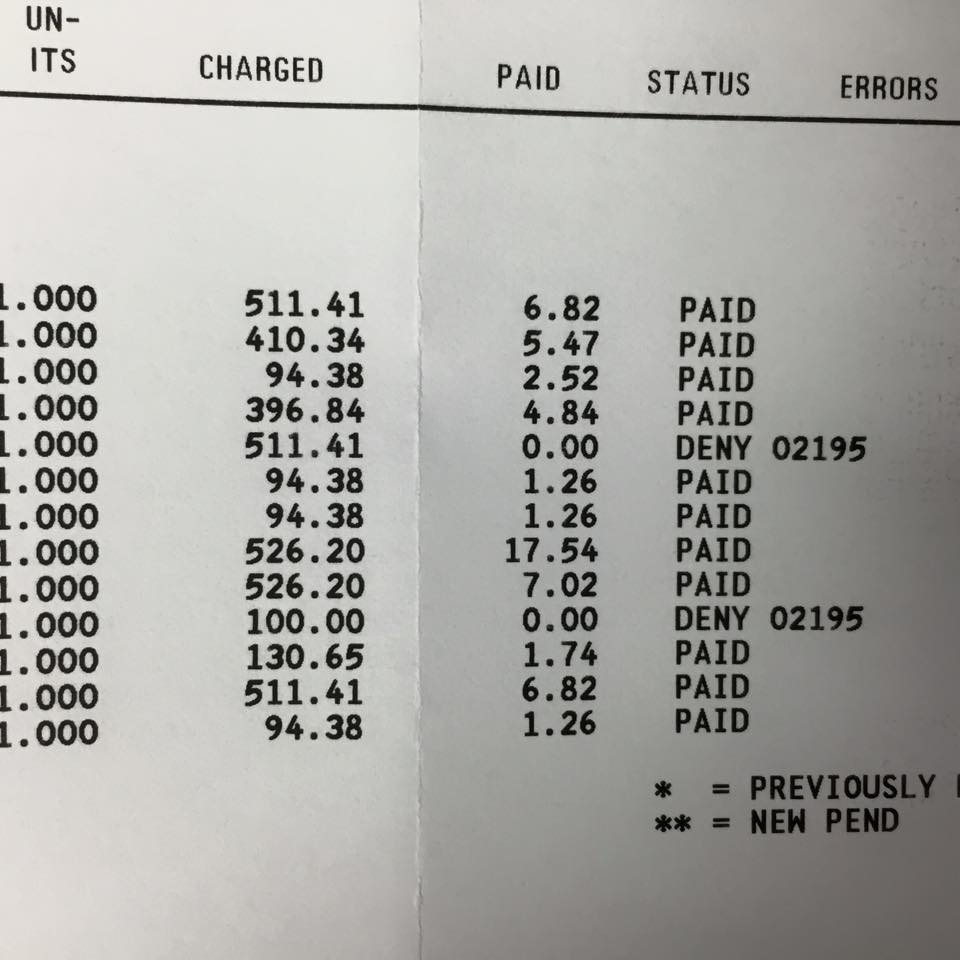
Well, our friend Dr Val has a pretty graphic answer:


Click on over to read the whole story (and definitely check out the comments).

Another Installment of: That's NOT how it works

It seems like only a  week ago that we referenced our 2nd ever post - wait, it was a week ago that we did that! And here we are again, talking about insurance fraud. And this one's a doozy:

"Irina Vorotinov has been charged by ... with defrauding Mutual of Omaha Insurance Company of more than $2 million in life insurance proceeds by falsely claiming that her former husband had died."

Turns out - Spoiler Alert! - the ex- was, in fact, very much alive, and caught on film years after his alleged death.

Ooops.

Thursday, January 29, 2015

Super(bowl) Health Wonk Review is up

Our favorite health care economist, Jason Shafrin, hosts this week's festive round-up of health care policy and polity. It's cold outside, so come in and warm up with some great reads.

Wednesday, January 28, 2015

Popcorn State Expansion

On February 1, 2015 Indiana will become the 28th state to expand Medicaid. Good news (I suppose) for
those under 138% of the FPL. No more insurance premiums.

But you may have trouble finding a doctor. This is nothing new nor indigenous to Indiana. Medicaid participants in all states have trouble finding doctors willing to take them as new (or even old) patients.
About 765,600 Hoosiers lacked insurance in 2013, according to the Kaiser Family Foundation. The state has estimated more than 300,000 Hoosiers — or 56 percent of those newly eligible for Medicaid — could enroll in the first year and more than 400,000 would sign up during the second year. - Indy Star
Agents that wrote Obamacare subsidized plans on those under 138% of the FPL can probably expect to lose those clients ....... and the revenue.

How is the expansion funded?
The federal government pays for 100 percent of the cost through 2016. That declines gradually to 90 percent by 2020, assuming Indiana's waiver is extended past three years. Indiana's share — estimated to be about $1.6 billion between 2015 and 2021 — will be paid for through the state's existing cigarette tax and from a tax on hospitals.
Funded by the federal government, which doesn't have any money.

And funded by smokers and hospitals.

Increasing the cost of cigarettes probably isn't bad in the big scheme of things but taxes on hospitals will increase the cost of health care. How is this a good thing?

So, what is a Hoosier any way? I have heard it comes from "Hoosier mama" which I suppose is a version of "Yo mama".

Regardless, I wonder if this is a good thing or not.

Some thoughts on subsidies

So, been having a bit of a Twitter-tussle with a well-regarded friend and colleague. At issue is the future of ObamaTax subsidies as we look forward to the resolution of Burwell/King/Halbig.

Which got me to thinking: Why we're having this discussion at all? After all, President Obama explicitly promised us that, under the ObamaTax, premiums would decrease 3000%, and that we would have comprehensive, affordable coverage.

If this were truly the case, then why would we need bribes subsidies in the first place? After all, who wouldn't want cheap, useful insurance coverage? Why would we need to be cajoled, nay, forced into buying it if it was such a great bargain?

And if, as Mike pointed out years ago, the folks in DC actually did their jobs, would we need to be expanding Medicaid?

Thought not.

Tuesday, January 27, 2015

Tuesday Spindle-clearing

In no particular order:

■ Coming as a surprise to no one who's been paying attention:

"A quarter of firms that that had offered insurance to their employees last year were canceling their health plans this year, and another 25% said they planned to do so next year."

This in Michigan, and focused on smaller companies not (yet) subject to the Employer Mandate. Talk about blizzards...


Could treating Alzheimer's really be this simple?

"Researchers say they’ve developed a nasal spray that could potentially improve memory and other mental capabilities for the more than 5 million Americans suffering from Alzheimer’s disease."

It's still a long way off (and currently being tested only on those with mild cases), but sounds promising.


Almost 5 years ago, we wrote about a "Lifespan Calculator:" an online widget that purported to predict how many days one had left. It appears that the technology is improving:

"A test to determine if elderly patients will die within 30 days of being admitted to hospital has been developed by doctors to give them the chance to go home or say goodbye to loved ones."

Corrected for accuracy:

"A test to determine if elderly patients will die within 30 days of being admitted to hospital has been developed by doctors to encourage them onto the Liverpool Pathway."

There, better.


But hey, "middle class:"

"I’m sorry sir,” the polite Healthcare.gov customer-service agent said. “There’s nothing I can do. You’re either going to have to enroll in Medicaid or you’re going to have to pay the full health-insurance rate.”

The problem, of course, is that the gentleman in question had the misfortune to fall within the one category for which the ObamaTax was supposed to work, but never quite has. As a grad student, he wasn't worried about his next BMW, but neither was he worried about his next meal. Couple that with the problem that, if one is eligible for Medicaid one is not eligible for a subsidy, and one begins to see the problem.

I really like the author's take on this, by the way: "Call me crazy, but in my book Medicaid is a last resort, not a first option."

It's so easy to forget that this is no game, no theory; it hurts real people, every day.

DC's Best Kept Secret

What with all the reports of how well Open Enrollment v2.0 has been going, it's no wonder the folks in charge want to keep this under wraps:

"It will cost the federal government – taxpayers, that is – $50,000 for every person who gets health insurance under the Obamacare law"

But that's only the tip of the proverbial iceberg:

"It will take $1.993 trillion, a number that looks like $1,993,000,000,000, to provide insurance subsidies ... and to pay for a massive expansion of Medicaid and CHIP"

But hey, worth it to provide universal health insurance coverage.

Wait, what?

"The best-case scenario described by the CBO would result in 'between 24 million and 27 million' fewer Americans being uninsured in 2025, compared to the year before the Affordable Care Act took effect."

So after 15 years and $1,993,000,000,000, they still won't have everyone covered?

Gee, sure glad they passed it to find out...

(And notice, one has to go to the UK press to find this)

Monday, January 26, 2015

Solution for Austerity Cuts in Health Care

If your government is running out of money and cutting services to balance the budget, what
do you do?

Elect a liberal.

Greece has been teetering on bankruptcy for years thanks to too much government and too many social give away programs. All that is about to change as a result of this weekends election
In Greece’s biggest hospital, the Evangelismos Hospital in Athens, conditions were worse than those I have seen in developing countries.
The moment the hospital doors open on ‘emergency’ days, people flood in. The collapse in official primary and community health care services means everyone who needs healthcare comes to A+E - whether for a major accident, medication for a long term condition or to get their child immunized. Staff told me that serious trauma cases often have to wait hours for X-rays and treatment due to understaffing and that, if too many cases come in at the same time, people die before they can be treated. - Open Democracy

The "austerity program" has saved the country but at what price? 
The government had closed all the polyclinics then reopened some recently but with only 30% of the doctors that they need. Whereas previously there had been 150 doctors providing services to the district, there were now only 50. A polyclinic for a population of 400,000 people had no gynaecologists, no dermatologists, and only two cardiologists.
 “We want our doctors back” – said one of the volunteers I spoke to. Thousands of doctors have left the country. Those that remain – including senior hospital doctors - earn about €12,000 ( $13,400 US) a year.
The good news?

Greater access to health care (presumably).

The bad news?


Eventually Greece will run out of money (again) and they are back to square one. There is no free lunch.


CoOpportunity assumes room temp

Last month, we reported on the travails of Iowa's CoOpportunity Health, a start-up recently taken over by Hawkeye State regulators. FoIB Josh Archambault tips us that they've now been shuttered:

"Iowa’s insurance regulator plans to shut down insurer CoOportunity Health, marking the first failure of one of the nonprofit cooperatives created under the Affordable Care Act."

T'won't be the last.

Friday, January 23, 2015

Flashback Friday

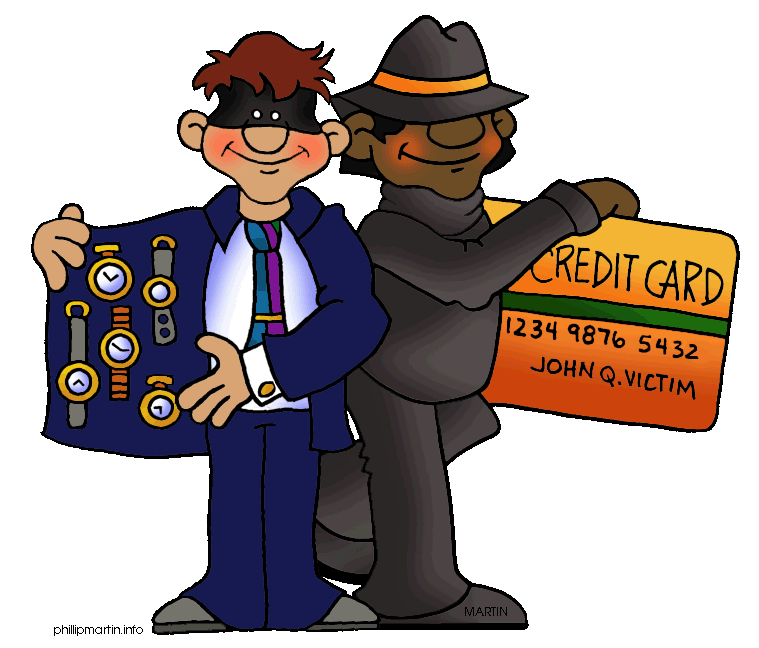
Our 2nd ever post here was a recap of the "Top Insurance Swindlers" of Ought-four. It was a rogues gallery that included a "greedy granny" and an arsonist pastor, among others (no mention of the apocryphal cigar owner). In fact, you'll notice an edit dated earlier this month: a business owner had emailed me requesting that I modify an entry because - ten years on - it was adversely affecting her business.

Fast forward a decade, and we have the truly inspirational story of an entire family of (alleged) insurance fraudsters:

"Authorities said the ensuing probe uncovered a decades-long pattern of questionable insurance claims ... Six other people, including her husband, two children and daughter-in-law, also face charges."

Bet Thanksgiving dinner is a hoot.

Thursday, January 22, 2015

Obamacare with Thin Crust or Thick?

Next time you order a pizza think about Obamacare. The same folks that brought us lower health insurance
premiums and better coverage are helping us make better choices when it comes to pizza.
The FDA finalized an Obamacare-mandated rule in November that requires restaurants to display calorie information on their menus. However, there appears to be some confusion over what the FDA calls a “menu.”
I J Review

A menu is what the server hands you in a restaurant.

But it can also be a web page, advertising flyer, clip and save coupon .........

To make matters more complicated,
Considering that Domino’s customers can customize their own pizzas, there is an endless number of possible combinations of toppings, each of which has a different calorie count. Liddle said a low-ball estimate of combinations Domino’s offers is 34 million. Pizza Hut has 2 billion possible combinations.
Maybe pizza's should be broken down into 4 simple categories.

Bronze, silver, gold and platinum.

That would simplify everything.

Medicaid and Long Term Care

Many folks continue to believe - erroneously - that Medicare will cover most (if not all) of their long term care needs. It won't. But Medicaid probably will, if you lack the assets to self-pay.

Unfortunately, this requires that one "spend down" one's assets, accumulated over a lifetime of toil. To qualify for assistance from Medicaid to cover long term care expenses, one is allowed to keep only a small amount of cash, a home and a car, maybe a few baubles.

The good news is that buying a Partnership-qualified long term care insurance plan, one may offset some of that spend down, and keep more assets.

And, as local ElderCare Law guru Michael Millonig informs us via email this morning:

"Level of Assets That Spouses of Medicaid Recipients May Keep Rises for 2015 ... [For example] If a couple has $100,000 in countable assets on the date the applicant enters a nursing home, he or she will be eligible for Medicaid once the couple's assets have been reduced to a combined figure of $52,000 -- $2,000 for the applicant and $50,000 for the community spouse."

Click on through for more details.

Wednesday, January 21, 2015

Is Healthcare.gov really just a massive voter data collection tool for DNC? [UPDATED]

[Scroll down for update]

Seeing how Obama has abused the IRS and voter registration this isn't such a stretch:
"Daoudi's company — Catchpoint Systems— came across some 50 third-party connections embedded on HealthCare.gov. They attracted attention because such connections can slow down websites. They work in the background, unseen to most consumers.
The AP was able to replicate the results. In one 10-minute visit to HealthCare.gov recently, dozens of websites were accessed behind the scenes. They included Google's data-analytics service, Twitter, Facebook and a host of online advertising providers."
A list of 9 million potential voters who "benefited" from government largess along with their facebook and twitter friends would be very valuable come Get Out the Vote time.  

UPDATE [HGS @ 1/21/15]: And it gets worse:

"... healthcare.gov – the flagship site of the Affordable Care Act, where millions of Americans have signed up to receive health care–is quietly sending personal health information to a number of third party websites."

Including Doubleclick.net, Twitter and even Youtube.

Hey, if you like your privacy, you can keep....

A Giveaway is Now a Threat

As open enrollment creeps across the finish line in year two, many organizations that support Obamacare are changing their marketing plans. The first year and the opening of this year focused on the ever popular "giveaway" model. It came in two parts.

1. Give people something for free. From free birth control to free preventive care people should sign up for health insurance because these benefits wouldn't cost anything. Never mind the fact that doctors and pharmacies aren't really giving this stuff away.

2. Explain that Government thinks this is important for you to have insurance so they are paying the majority of your premiums. Never mind the fact that if your income is above $20,000 to purchase a Silver Level plan you will pay 5% of your income for it. Never mind the fact that cheap insurance means high out-of-pocket costs for health care.

Now comes the third marketing campaign:  Explain the consequences of not buying insurance. The dreaded and unpopular individual mandate and the tax you have to pay for not buying government approved health insurance with free stuff in it. Never mind the fact that you are being taxed to help pay for parts one and two above.

Yep, that should do the trick.

Tuesday, January 20, 2015

Everything Old is New (Again)

Way back in the early days of this blog, we reported on a seasoned citizen who chose a life at sea as her Long Term Care plan:

"On our October cruise on Royal Caribbean lines, there was an elderly lady who actually resided on the ship 'Voyager of the Sea ... She told us that it was just more financially feasible to do this than living in an assisted-living home and was much more fun"

So it was with a sense of deja vu that I read this item this morning:

"Lee Wachtstetter, an 86-year-old Florida widow ... sold her five bedroom Fort Lauderdale area home on 10 acres and became a permanent luxury cruise ship resident ... has been living on the 1,070-passenger vessel longer than most of its 655 crew members — nearly seven years."

One interesting tidbit: in our original story, the traveling senior reported spending over $200,000 a year; by contrast, Mrs Wachtstetter seems to have scored quite the bargain at a little over $160,000 annually.

Sweet Sailing, Mama Lee!

Monday, January 19, 2015

Counting down the ObamaTax

As you've no doubt seen all over the news, once Open Enrollment v2.0 is over next month, folks who failed to take advantage of it and are still uninsured will (likely) be subject to a fine penalty tax. Many (most?) folks believe that the tax is a mere $95 this year and, for some people, this may well be the case. But it's actually just a minimum; the actual rate (this year) is 1% of income:

"TurboTax, an online tax service, estimated that the average penalty for lacking health insurance in 2014 will be $301."

On the one hand, that's a lot more than $95, but on the other, it's likely less than one month's premium, especially for folks who don't qualify for a subsidy.

Just for grins and giggles, I took an average person (age 35) living in the Mid-West and ran some quotes. I chose Anthem because, let's face it, Blue Cross is ubiquitous and, in many markets, the 800 lb gorilla. My hypothetical client, of course, eschews tobacco.

The least expensive plan available cost $253, and includes a maximum potential out-of-pocket (MOOP) liability of an additional $6,400 if he has a bad year. But assuming that, like most folks, his expenses are generally a flu shot and maybe a generic prescription (available for $4 at many retailers), this doesn't seem like such a good deal. It would take less than two months to be "in the hole" vice "going naked."

Now let's back up a bit and consider his younger brother, aged 28: he's eligible for a "Catastrophic" Plan (not to be confused with an HSA-compliant one), which comes with a MOOP of $6,600, and costs $180 per month. Again, a couple of months into it, and he's well past the $301 fine penalty tax, too.

Bottom line: why would anyone think that this is an efficient incentive?

Friday, January 16, 2015

Sold Out

In an unusual move, Community Health Alliance has pulled their product off the exchange in Tennessee.

Community Health Alliance has pulled its health insurance plans off the federal marketplace because it hit its enrollment goals.
Knoxville-based Community Health Alliance, a nonprofit consumer operated and oriented insurance provider, or co-op, hit its enrollment goals in the first two months of open enrollment. It stopped offering plans on the exchange Jan. 15.

No carrier has ever done this before (pulling a product in mid-year). Is this the first of many or simply an anomaly?

Thursday, January 15, 2015

Health Wonk Review: Welcome to '15 edition now up

Vince Kuraitishos hosts this week's eclectic round-up of the first wonky blog posts of the New Year.

MVNHS© In The News

Since it's been a while since we've reported on the Much Vaunted National Health Service©, seems like it's a good time to catch up:

1 - Co-blogger Bob alerts us to this alarming news:

"More than 3,000 operations have been cancelled by the NHS in the first two weeks of [December] as an "unprecedented demand" takes its toll."

Here's the deal: When something is "free" (or, more precisely: perceived as free) then more folks are going to want it. After all, why would anyone in their right mind leave money (or health care) "on the table?"

It also points out that nationalized health care schemes do nothing to rein in demand, and by extension, cost.

2 - FoIB Peter K explains why the folks mentioned above may have been lucky to have been put off:

"A six-week-old baby was killed by her bipolar mother after she stuffed pages from the Bible into the infant's mouth, while supposedly in the care of bungling NHS staff."

What difference which book was used seems irrelevant and unhelpful; the important information here is that careless (overworked?) staff allowed such a person unfettered, unsupervised access to a vulnerable patient in their charge.

Could it happen here? Of course, but the difference is that this seems to be a pattern for MVNHS© folks:

"Other fatal errors by the Cambridgeshire and Peterborough NHS Trust included the shocking loss of records detailing an attempt by Lovemore in 2006 to smother her first child."

And that was just this one family.

Oy.

Wednesday, January 14, 2015

A Timely Reminder

Bob G vs "Survey Says!"

FoIB Bob Graboyes takes to the pages of US News to explain why judging the success (for certain values of "success") of the ObamaTax, based on ubiquitous and often self-selecting surveys, is destined to be disappointing:

"The phrasing of questions matters a great deal. Individuals surveyed may answer a pollster’s question dishonestly for a variety of reasons, or they may answer incorrectly because they don’t actually know whether they have qualifying insurance coverage."

Or maybe they think their better half took care of it. Doesn't really matter: you know the old saw about lies, damn lies and...

Bob wants to know just one simple thing: Why must we rely at all on these consumer surveys? They are subjective and prone to bias (both intentional and inadvertent). Surely there must be a better way?

And indeed there is. But you'll have to read his article to see what it is.

(It's worth it)

Tuesday, January 13, 2015

Bucks, Ducks and Luck

Congratulations to The Ohio State Buckeyes for their impressive route of the University of Oregon Ducks last night in Texas. While most of us here in Buckeye country are busy celebrating the win, one regional retailer is licking its wounds:

"Ohio-based Morris Furniture Company is now on the hook for upwards of $1.5 million in refunds to customers ... The promo promised refunds to customers who purchased at least $1,999 in furniture a ... if OSU won the championship game by at least seven points."

Which, by golly, they did.

So the chain is on the hook for an estimated $1.5 million dollars. That's the bad news. The good news is that they took a page from Chicago's World Furniture Mall, about which we wrote some 8 years ago:

"[The store] promised that if the Bears shut out the Packers in the season opener at Lambeau Field in Green Bay, Labor Day weekend shoppers would get their furniture free."

Which is what happened. Fortunately, the owner had purchased a "Special Event" policy for just such an occurrence, and was out only the price of the plan. So, too, the Ashley's folks "did work with a third-party company that underwrote the promotion."

Smart move.

Frustrating Client Tricks

First off, let me be clear that it's the client (and myself) that's frustrated. It's just that kind of situation:

Mary is divorced, and has custody of her teenaged son.She is responsible for his health care expenses, but her ex- is supposed to provide health insurance. Unfortunately, he is not terribly reliable: he is frequently unemployed (and uninsured), and he doesn't always let Mary know whether or not their son's actually covered.

In order to alleviate the stress of that inconsistency, Mary has always kept her son on her insurance. Due to some recent employment woes, she purchased a subsidized ObamaPlan from the Exchange.

A few weeks ago, her ex- contacted her to let he know that he'd found new employment, and that he and their son would become active on the new group plan on February 1. This presents her with something of a dilemma:

Once her son is on the group plan, he is no longer eligible for a subsidized plan. And according to Mary, she will also lose her subsidy (although she can keep the plan itself). Since I came into the picture after she'd already gone through the 404Care.gov subsidy eligibility hoops, I really can't confirm this, so I've just taken her at her word.

She also knows, from previous experience, that she really needs to keep her son on her plan, lest her ex- bail on the insurance requirement (yet again).

She asked her agent about what to do, and he referred her to me (this happens with some regularity).

I turned to my trusted posse (a group of colleagues around the country who are both expert and high integrity) for advice. I had a pretty good idea of what was going to happen here, but really wanted some additional input, especially regarding issues I might have missed.

Colorado Health Insurance Insider's Louise Norris came through in a big way.  Louise confirmed my belief that Mary "can't keep her son on a subsidized exchange plan. You can't get subsidies at all if you're even eligible for employer-sponsored coverage that is deemed affordable under the ACA rules (and unfortunately, because of the family glitch, they only look at the cost of coverage for the employee when they determine whether a group plan is affordable, regardless of whether dependents are being added to the plan or how much it would cost to add them)."

Louise also mentioned that Mary shouldn't lose her own subsidy just because Junior came off, but again, I  came in after she'd done that calculus, so I'm going to leave that lie (I have no idea how she completed the process).

Ultimately, it appears that the only way that Mary can resolve her dilemma is to drop her ObamaPlan and buy a new policy off-Exchange, one that will cover both her and her son. I pointed out to her that this solution has its own challenges; for example, having two plans in place often leads to Coordination of Benefits issues between the two carriers. She told me that she's done this before (where she kept him on both the ex-'s and her own plans) to no ill effect.

I am not satisfied with this solution, yet it appears that it's the only viable one if she wants to know that her son always has some insurance in place.

Still, better than nothing, one supposes.

Monday, January 12, 2015

Paying Medical Bills

A recent blog post by health care business consultant and policy expert David E. Williams suggests that medical bills are not paid because people do not understand them (as cited in a recent report by the Consumer Financial Protection Bureau). He then admits that “[e]ven though I’ve been working as a healthcare business consultant for more than 20 years, I don’t understand my bills either” and then lists several reasons for this misunderstanding. With all due respect to David, let's dissect this:

1) Providers send bills while insurance claims are still pending, so I don’t understand whether I’m being asked to pay the right amounts

In today’s modern medical offices, even those without EMR (electronic medical records), practices have Practice Management software which electronically bills insurance companies through organizations called clearing houses. When the provider receives the Explanation of Benefits (EOB) from the insurance carrier, the payment or if the patient owes is entered into the software and then a bill for the patient is generated based on the information from the insurance company. A provider would not bill while an insurance claim is pending as the software is not designed to generate a bill before the insurance information is entered. When you are billed by the provider, it is the correct amount.

2) Explanations of benefits from my health plan aren’t timely and aren’t informative. The services described sound completely generic and are hard to trace back to the provider bill

Your EOB should match the bill you receive from your physician’s office. Also, after the visit you the patient should receive a statement detailing your services, both the ICD-9 and CPT codes you were charged, the amount of money charged by the physician and any payment you made, such as a co pay or co insurance.

3) We now have a high-deductible plan and are being asked to pay more by our providers, but I’m not confident that providers are correctly taking into account our out-of-pocket maximums on an individual and family basis

As a medical practice manager, I am astounded that someone that purports to be a health care advisor would make such an inflammatory statement about medical providers. Going back to point one, the provider bills only after receiving the information from the insurance company on the patient’s portion. It is not any provider's responsibility to keep track of a patient’s deductibles, that is the patients responsibility and it is between the patient and the insurance company.

4) Providers aren’t coding claims in line with the Affordable Care Act or insurance company rules, resulting in incorrect out-of-pocket amounts

Mr. Williams then cites another post in which he discusses the “free” services to be offered by the provider, such as preventive care annual physical or the “free" screening colonoscopy. This is an oft misunderstood aspect of medical care: these services *can* be paid at 100% *provided that* the exam is purely a review, and there are no diagnostics, tests, labs etc. The minute you say, “by the way doc, my arm hurts when I do this”, it is no longer a preventive exam, it is now diagnostic and your deductible and/or co-pays will apply. Now, the logical question is, isn’t talking to the doctor about things that hurt the whole reason for seeing a doctor? Yes it is, but hey I didn’t make up the rules, I only follow them. So providers are not incorrectly coding, we are coding what actually happened.

5) Few providers (at least around here) allow online payments. I have to either call the office during work hours or mail in a check –both a hassle

Really, David? Many (most?) banks now allow for on-line bill-paying, no reason you can't set that up to pay for health care, as well. Heck, if you're on an HSA-compliant plan (as it appears you might be), you could even pay those bills from your HSA account.

This article is a rehash of every complaint I have heard in my 15 years working in health care. Why is paying your doctor any harder than paying your cable bill or your credit card bill? It is an expense you incurred of your own free will when you went to see your doctor. You know that you will receive a bill, especially with the average deductible north of $2500, and yet each patient is always surprised when the bill arrives in their mail box: “Is this the correct amount?” or “Have you billed my insurance company?” or “The doctor said he wasn’t going to bill me. My favorite is “I don’t think I should have to pay: 1) for my healthcare, or 2) such a high amount”. I have heard every excuse and reason not to pay a medical bill, and in my experience the provider is correct 90% of the time.

Friday, January 9, 2015

Results Are In And It Isn't Pretty

Early Obamacare results from the carrier side are looking ugly. An Assurant financial statement is revealing for the first 9 months of 2014.

A 3rd quarter loss of $17M might not seem like much but you have to factor in a couple of things.

Assurant is a relatively small player in the individual health insurance market. The $17M loss contrasts with a $6M net operating gain for the same period a year earlier.

Then there is this ..........

Net operating loss in third quarter 2014 was driven by increased claims from Affordable Care Act (ACA) qualified policies. Results reflect estimated recoveries from the ACA riskmitigation programs.
Note: In 2014, ACA risk-mitigation programs designed to reduce the potential adverse impact to individual health insurers from health care reform provisions went into effect. Assurant Health is eligible to participate in the risk-adjustment and reinsurance programs. As of Sept. 30, 2014, estimated recoveries under these two programs totaled $257 million. 
If not for the "taxpayer bailout" the losses would have exceeded $274 million.

I think Assurant and the other carriers should send us a thank you note.